Jun 29, 2011


Jun 28, 2011
THE TROLLS by Polly Horvath
taken from best-chilrens-book.com, review by Sarah Denslow
Meet storytelling Aunt Sally
The eccentric aunt: pretty much everyone has one (at least pretty much all fictional characters), and the Anderson kids are no exception.
 Melissa is ten, the oldest, and “always knows everything”; Amanda is eight and “often knows everything”; Pee Wee is six and “knows nothing” (at least in the estimation of his sisters. Pee Wee does, however, provide a good deal of comic relief prior to the arrival of Aunt Sally by continually wondering if the children will be sent to a kennel when their babysitter has to cancel, due to contracting a case of the bubonic plague.
Mom and Dad aren’t nuts about leaving Aunt Sally with the care of their three offspring, but they can’t find anyone else, and there are those non-refundable tickets to Paris to consider. Mom leaves a very detailed list of what the children need to do, including suggested vegetables for each day of the week, and then they’re off.
Aunt Sally proves to be both an interesting and loquacious adult. She ensures that the children will eat their green beans by eating her own with such gusto and creativity (including pantomiming knitting with two) that the children can hardly stand not to eat them and entertains them with stories of growing up in Vancouver.
The stories are wonderfully entertaining, if just a bit incredible, and include a hilarious story of Great-uncle Louis trying to get Aunt Sally’s brother to eat his vegetables by chasing him down with a handful of the things. But if his childhood in Canada was so wonderful, why, Melissa and Amanda to know, doesn’t their dad ever talk about Vancouver himself?
Well, says Aunt Sally, it might have something to do with the Trolls. What trolls? Aunt Sally says she’ll tell Melissa and Amanda, but they mustn’t let Pee Wee hear because he might get nightmares. read more....
Meet storytelling Aunt Sally
The eccentric aunt: pretty much everyone has one (at least pretty much all fictional characters), and the Anderson kids are no exception.
Now that Aunt Sally is really coming to stay with them, though, (and not just stay, but actually take care of the kids while their parents are in Paris) Melissa, Amanda, and Pee Wee are about to find out just what this aunt, who sends them Christmas cards with a picture of a moose every year, is really like.
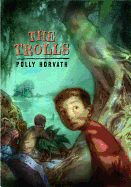 Melissa is ten, the oldest, and “always knows everything”; Amanda is eight and “often knows everything”; Pee Wee is six and “knows nothing” (at least in the estimation of his sisters. Pee Wee does, however, provide a good deal of comic relief prior to the arrival of Aunt Sally by continually wondering if the children will be sent to a kennel when their babysitter has to cancel, due to contracting a case of the bubonic plague.
Mom and Dad aren’t nuts about leaving Aunt Sally with the care of their three offspring, but they can’t find anyone else, and there are those non-refundable tickets to Paris to consider. Mom leaves a very detailed list of what the children need to do, including suggested vegetables for each day of the week, and then they’re off.
Aunt Sally proves to be both an interesting and loquacious adult. She ensures that the children will eat their green beans by eating her own with such gusto and creativity (including pantomiming knitting with two) that the children can hardly stand not to eat them and entertains them with stories of growing up in Vancouver.
The stories are wonderfully entertaining, if just a bit incredible, and include a hilarious story of Great-uncle Louis trying to get Aunt Sally’s brother to eat his vegetables by chasing him down with a handful of the things. But if his childhood in Canada was so wonderful, why, Melissa and Amanda to know, doesn’t their dad ever talk about Vancouver himself?
Well, says Aunt Sally, it might have something to do with the Trolls. What trolls? Aunt Sally says she’ll tell Melissa and Amanda, but they mustn’t let Pee Wee hear because he might get nightmares. read more....
Jun 27, 2011
Jun 17, 2011
STATE OF WONDER by Ann Patchett
 This is the background to the arrival of a letter that ignites Orange Prize-winning American novelist Patchett’s exhilarating if overheated work. Some weeks earlier, Anders had been sent to the Amazon to report on the work of a reclusive but brilliant doctor, Dr Swenson, who has spent decades studying a tribe whose womenfolk continue to bear children into their seventies. The company which employs Marina and Anders pays for her research, and is frustrated at the time it’s taking the doctor to produce results. Anders needs to find out why she is taking so long. The letter, however, contains dreadful news. It is from Dr Swenson, informing them Anders has died.
Marina is a homebody, attached to Minnesota, despite her Indian heritage, as if by chains. It is a measure of her fidelity to her friend and his grieving widow, and of her innate biddability that when Mr Fox asks her to go to Brazil and learn what happened, and how the uncommunicative doctor’s work is going, she agrees. What follows is a compellingly taut story in which a series of adventures containing vivid individuals throws up profound revelations.
Patchett is a highly empathetic writer, subtle in her characterisations and in her portrayal of strong attachments, unbidden feelings and the complications that attend both.
Marina emerges as a truly delightful and admirable heroine, a woman whose story one would like to follow beyond this book. As she investigates Anders’s death, she is obliged to confront her own past when, as a promising young doctor, she made a terrible mistake. That incident not only crippled her professionally but, it appears, emotionally too. This trauma is linked to Dr Swenson, which makes Marina’s trip doubly courageous.
One can’t but wonder, though, why a woman who willingly braves the Amazonian interior, with its cannibal tribes, its alphabet of snakes, spiders and insects, and a fanatical doctor, would have been so easily derailed in her earlier life.
The Amazonian forest is as unwelcoming as Dr Swenson: “At dusk the insects came down in a storm, the hard-shelled and soft-sided, the biting and stinging, the chirping and buzzing and droning, every last one unfolded its paper wings and flew with unimaginable velocity into the eyes and mouths and noses of the only three humans they could find.” Yet it is in the terrifying isolation of this wildly dangerous environment that Marina proves what she is made of.
Here, as in other novels, Patchett explores the nature of love and duty, and the huge responsibilities those small words carry. A pellucid, droll writer, she reveals her Tennessee upbringing in a penchant for drama that verges on the gothic. Where she fails to convince, for this reader at least, is in her portrait of the Amazon settlement. This setting, with its enigmatic tribe and their peculiar habits, gives rise to such extreme turns of event, it’s as if one has crossed a line from literary fiction into boy’s own territory. Added to which, the hinge on which Patchett’s plot turns is not hard to predict. This does not spoil one’s pleasure, but it diminishes the novel’s power. It is no small feat, then, for Patchett to surmount her over-egged plot to create a tender, affecting and memorable novel.
Jun 13, 2011
MY TATTOOED DAD by Daniel Nesquens & Magicomora
taken from Last Gasp
 A young boy describes what life is like when his dad comes home -- how he fries up chicken samosas for dinner, how he makes jokes and fools around, and how he carries him off to bed when he is sleepy. His dad also tells wonderful stories of his adventures in far-off lands, often inspired by his many, many exotic tattoos. His letters to his son are also full of great stories about the past -- what the first date with his mother was like (it included a visit to a fortune teller and a bizarre circus) and about how the boy's life was saved twice by this very same dad -- once when he was stolen from his baby basket by a dog and once when he flew out the car window. But as his mother says, his dad has ants in his pants, which means he's often not around. Still, life rolls along with one fantastical tale after another, in good times and bad. And this is this extraordinary father's gift to his child -- the life of the imagination -- which is always with him, even when his father is not. The illustrations have a nostalgic, underground graphic-novel style feel to them that perfectly complements the very original text. Ages 4-8.
Daniel Nesquens is a prolific, award-winning author who has written books for children and young adults, many of them available in either bilingual or Spanish editions in North America, including Caminando sobre el alambre, Como pez en el agua, D?as de Clase / School Days (Sopa de Libros / Soup of Books), Papa tenia un sombrero / Dad Had a Hat (Sopa De Libros / Soup of Books) and Mi familia / My Family. Several of his books have been listed in the White Ravens Catalogue and have been recognized by Venezuela's Banco del libro in "Los mejores libros para ni?os y j?venes" (the best books for children and youth). He lives in Zaragoza, Spain.
Magicomora is one of the most important pop surrealist artists in Spain and has exhibited his work all over the world. He is also a children's book illustrator with more than fifteen books to his credit. The Spanish edition of My Tattooed Dad was named best children's book by the Association of Illustrators of Catalonia. Magicomora lives in Barcelona, Spain.
Jun 8, 2011
TWELVE STEPS TOWARDS POLITICAL REVELATION by Walter Mosely
taken from Perseus Academic
 In his late teens and early twenties, Walter Mosley was addicted to alcohol and cigarettes. Drawing from this intimate knowledge of addiction and recovery, Mosley explores the deviances of contemporary America and describes a society in thrall to its own consumption. Although Americans live in the richest country on earth, many citizens exist on the brink of poverty, and from that profound economic inequality stems self-destructive behavior.
In Twelve Steps to Political Revelation, Mosley outlines a guide to recovery from oppression. First we must identify the problems that surround us. Next we must actively work together to create a just, more holistic society. And finally, power must be returned to the embrace of the people.
Challenging and original, Recovery confronts both self-understanding and how we define ourselves in relation to others.
About the Author
Walter Mosley is the author of more than thirty-four critically acclaimed books, including the bestselling mystery series featuring Easy Rawlins. He is the winner of an O. Henry Award, a Grammy, and PEN America's Lifetime Achievement Award. He lives in New York City.
Subscribe to:
Posts (Atom)