Sep 5, 2011

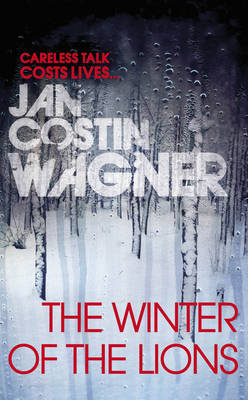
THE WINTER OF THE LIONS by Jan Costin Wagner

source: The Random House Group

Every year since the tragic death of his wife, Detective Kimmo Joentaa has prepared for the isolation of Christmas with a glass of milk and a bottle of vodka to arm himself against the harsh Finnish winter. However, this year events take an unexpected turn when a young woman turns up on his doorstep.

Not long afterwards two men are found murdered, one of whom is Joentaa’s colleague, a forensic pathologist. When it becomes clear that both victims had recently been guests on Finland’s most famous talk show, Kimmo is called upon to use all his powers of intuition and instinct to solve the case. Meanwhile the killer is lying in wait, ready to strike again…

In Kimmo Joentaa, prizewinning author Jan Costin Wagner has created a lonely hero in the Philip Marlowe mould, who uses his unusual gifts for psychological insight to delve deep inside the minds of the criminals he pursues.

Jul 5, 2011

The Paperback Game

taken from the New York Times
written by


Here’s what you’ll need to play: slips of paper (index cards work well), a handful of pencils or pens and a pile of paperback books. Any sort of book will do, from a Dostoyevsky to a Jennifer Egan, and from diet guides to the Kama Sutra. But we’ve found it’s especially rewarding to use genre books: mysteries, romance novels, science fiction, pulp thrillers, westerns, the cheesier the better. If you don’t have well-thumbed mass-market paperbacks in your house, you can usually buy a pile from your library, or from a used-book store, for roughly 50 cents a pop.

Many people flee from games they fear will be public I.Q. tests or will expose gaps in their literary knowledge — their inability to differentiate between, say, Lily Bart and Isabel Archer, or between John Barth, Roland Barthes and Donald Barthelme. This is not that kind of game. A little learning helps. But I’ve seen precocious preteenagers wipe the floor with fairly elite published writers. Which is another way of saying that even nonmandarins can play the paperback game and sometimes win.

Once you’ve gathered your loved ones at the table — 4 to 10 is optimal — and opened fresh bottles of wine and perhaps put on an old Ry Cooder record, here is how the game unfolds. One player, the “picker” for this turn, selects a book from the pile and shows its cover around. Then he or she flips it over and reads aloud the often overwrought publisher-supplied copy on the back cover.

Hearing these descriptions read aloud is among the game’s distinct joys. Here is one example, from the back cover of a paperback titled “Paradise Wild” (1981), by Johanna Lindsey. Try to imagine the following recited in the voice of the fellow who does the husky voice-overs for coming attractions in theaters, or by your slightly tipsy best friend:

“A well-born Boston beauty, Corinne Barrows has traveled halfway around the world in search of Jared Burkett — a dashing rouge and a devil; a honey-tongued charmer who seduced and despoiled her ... and then abandoned the impetuous lady after awakening a need that only he could satisfy. She has found him on the lush and lovely island of Hawaii.” This goes on, but you get the idea.

One reason it’s less fun to play with serious rather than genre novels is that their back covers tend to contain phrases like “sweeping meditation on mortality and loss” rather than “a need that only he could satisfy.”
The other players absorb these words, and then write on their slips of paper what they imagine to be a credible first sentence for Ms. Lindsey’s novel. Essentially, they need to come up with something good — or bad — enough to fool the other players into thinking that this might be the book’s actual first sentence. Players initial their slips of paper and place them upside down in a pile at the center of the table.

Meanwhile the picker — the person who read the back cover aloud — writes the book’s actual first sentence on another slip of paper. He or she collects all the slips, mixing the real first sentence with the fakes, and commences to read each one aloud. Each person votes on what he or she thinks is the real first sentence. read more...

Jul 3, 2011

THE BOOK OF EVERYTHING by Guus Kuijer

taken from Nine Kinds of Pie - Philip Nel's Blog

Kuijer, The Book of Everything
“What do you want to be when you grow up?”
“Happy,” said Thomas. “When I grow up, I am going to be happy.”
 

Nine-year-old Thomas sees things that others don’t, like “tropical fish swimming in the canals,” thousands of frogs massing outside his house, and the loveliness of sixteen-year-old Eliza, who has “an artificial leg made of leather” and seems to understand him. Guus Kuijer’s The Book of Everything (2004, translated by John Nieuwenhuizen, 2006) is a brief, beautiful tale of Thomas losing faith, making friends with his sister and Mrs. van Amersfoort, gaining confidence in himself, and learning to resist his father’s bullying.  The prose is lyrical, the images are magical realist, and the story is full of wisdom and humor.  Here is a passage when Thomas, visiting Mrs. van Amersfoort, listens to Beethoven for the first time (the second sentence refers to her cat, who has been napping on a globe):

His ears started ringing again. The globe started spinning, cat and all. When he was about to draw Mrs. van Amersfoort’s attention to this, he saw that her heavy chair was floating above the floor like a low cloud. He barely had time to take this in when he felt the chair he was sitting in rising slowly, as if strong hands were lifting it. He wanted to shout with joy, but when he saw Mrs. van Amersfoort’s intent face, he realized that, with this music, it was normal for chairs to float. (19)

I love how this translates Thomas’s sense of wonder into a literal, physical experience. Kuijer does not tell us that Beethoven’s music makes them feel as if they were floating. Instead, they just float, borne upward in their chairs, drifting like low clouds. Beautiful.

The Book of Everything won the Flemish Golden Owl Award, but is not widely known in this country. It’s really, really good. I highly recommend it. I suspect that, once you read it, you’ll recommend it, too.

Jun 28, 2011

THE TROLLS by Polly Horvath

taken from best-chilrens-book.com, review by Sarah Denslow

Meet storytelling Aunt Sally

The eccentric aunt: pretty much everyone has one (at least pretty much all fictional characters), and the Anderson kids are no exception.

Now that Aunt Sally is really coming to stay with them, though, (and not just stay, but actually take care of the kids while their parents are in Paris) Melissa, Amanda, and Pee Wee are about to find out just what this aunt, who sends them Christmas cards with a picture of a moose every year, is really like.

Melissa is ten, the oldest, and “always knows everything”; Amanda is eight and “often knows everything”; Pee Wee is six and “knows nothing” (at least in the estimation of his sisters. Pee Wee does, however, provide a good deal of comic relief prior to the arrival of Aunt Sally by continually wondering if the children will be sent to a kennel when their babysitter has to cancel, due to contracting a case of the bubonic plague.

Mom and Dad aren’t nuts about leaving Aunt Sally with the care of their three offspring, but they can’t find anyone else, and there are those non-refundable tickets to Paris to consider. Mom leaves a very detailed list of what the children need to do, including suggested vegetables for each day of the week, and then they’re off.

Aunt Sally proves to be both an interesting and loquacious adult. She ensures that the children will eat their green beans by eating her own with such gusto and creativity (including pantomiming knitting with two) that the children can hardly stand not to eat them and entertains them with stories of growing up in Vancouver.

The stories are wonderfully entertaining, if just a bit incredible, and include a hilarious story of Great-uncle Louis trying to get Aunt Sally’s brother to eat his vegetables by chasing him down with a handful of the things. But if his childhood in Canada was so wonderful, why, Melissa and Amanda to know, doesn’t their dad ever talk about Vancouver himself?

Well, says Aunt Sally, it might have something to do with the Trolls. What trolls? Aunt Sally says she’ll tell Melissa and Amanda, but they mustn’t let Pee Wee hear because he might get nightmares.  read more....