Critic and friend of both Plath and Hughes, Al Alvarez ponders the rather 'uncooked' poem published for the first time last week
- guardian.co.uk, Monday 11 October 2010 13.24 BST
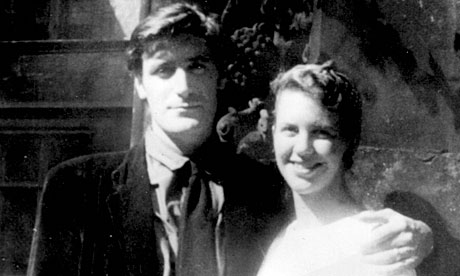 "Last Letter", found by Melvyn Bragg in the British Library with the help of Hughes's widow Carol, and published for the first time in the New Statesman this week, is more a document than a poem. I can see why Hughes spent so long rewriting it (there are at least three unfinished versions in the archive, apparently) and then deciding it still wasn't really ready for publication. To me it has a slightly uncooked air, though of course he was a wonderful poet and there are some great passages in it. What is interesting for us now is that it does go part-way to solving the mystery of what happened on the weekend before Sylvia Plath died. (She was found dead around midday on Monday 11 February 1963.)
According to the narrative of the poem, Plath wrote Hughes some kind of suicide note, or a note hinting at the possibility of suicide, on the Friday, and by some perverse miracle of the Royal Mail it arrived too early: she posted it in the morning and he received it in the afternoon post. So he got the message before she intended him to. As the poem tells us, he went round to her home, having read the letter, which she then burnt in an ashtray "with a strange smile".
What then happened, according to the poem, is that the worst of all the possible jealous fantasies that were torturing Sylvia at that time (when I last saw her, on the Christmas Eve before her death, she was in terrible shape) were fulfilled: the poem says he spent the weekend with a girl called Susan (whom Bragg identifies as the poet Susan Alliston), with whom Hughes was having an affair. He took her to rooms in Rugby Street, in London, where he and Plath had celebrated their wedding night. He then spent the weekend with Susan, in the same bed he had shared with Sylvia. Meanwhile, he imagines Plath calling him repeatedly at his flat and getting no answer.
In other words, the poem is a confession: he is a guy in the witness box pleading guilty. It's very strong stuff, but it ain't finished. And I suppose it is one of those documents that will now be pored over up by a host of biographers. What is certain is that Hughes spent the rest of his life tormented by what had happened, which is probably why the poem was never published in his lifetime. Unlike, say, John Donne's equally tormented but beautifully modulated "A Nocturnal Upon St Lucy's Day", Hughes must have decided that "Last Letter" was not balanced enough to be printed.